TL;DR: Most brand work disappears in hours. The stuff that builds trust sticks around for years. If you’re measuring impressions instead of longevity, you’re optimizing for the wrong thing.
I was scrolling through my analytics last week.
Open rates. Click-throughs. Impressions. All the numbers we’re supposed to care about.
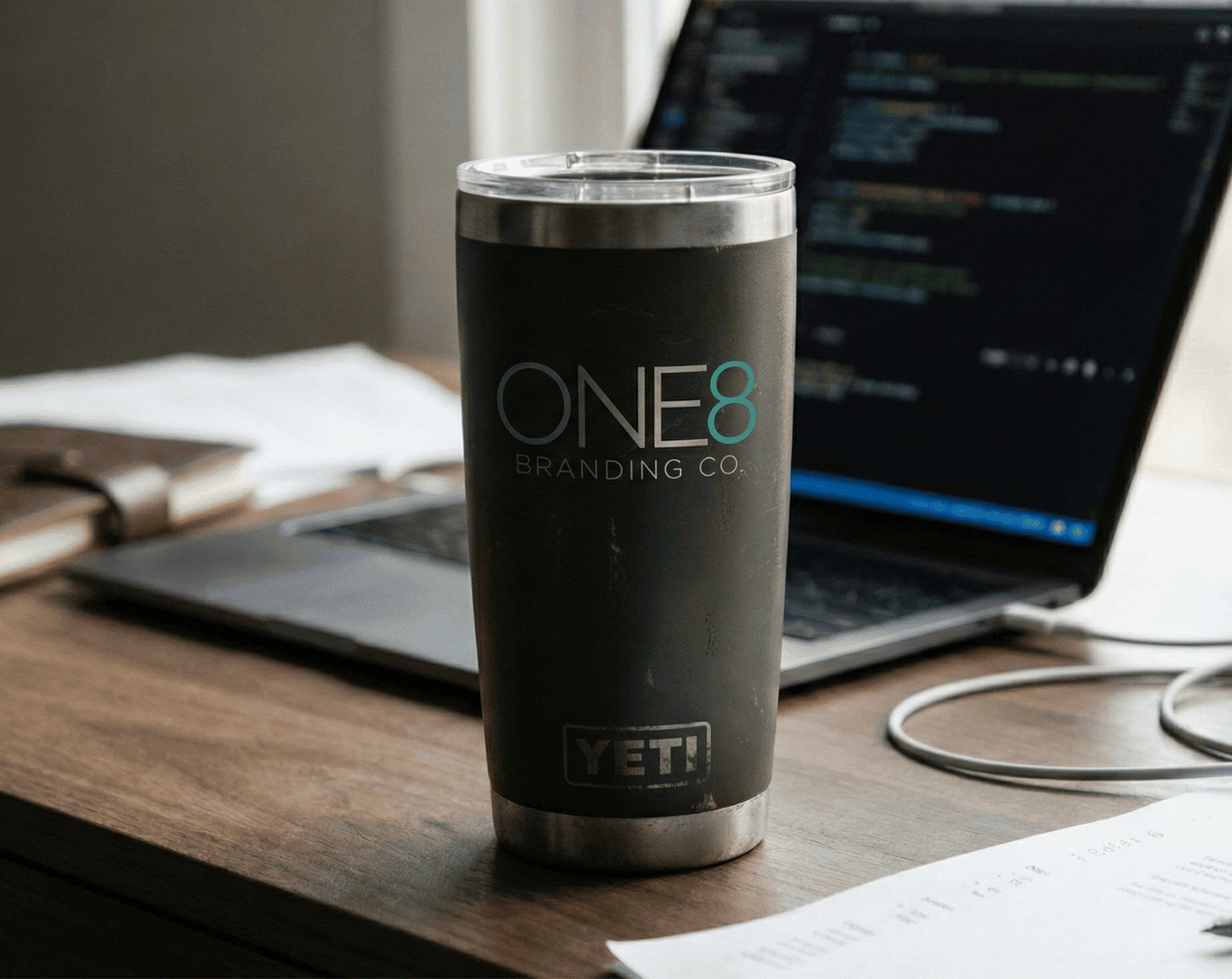
Then I looked up from my laptop. Sitting on my desk was a tumbler from a partner we worked with three years ago. I use it every single day.
That tumbler has delivered more “impressions” than any email campaign we’ve ever run. And nobody’s measuring it.
Most brand work is designed to expire.
The average social media post lives for a few hours. Email campaigns? Three days, maybe. Digital impressions reset to zero every morning. We’ve gotten incredibly good at creating work that vanishes on schedule.
Physical branded merch doesn’t work that way.
A well-made tumbler gets used daily. A quality hoodie stays in rotation for years. A thoughtful gift sits on someone’s shelf, visible in the background of every Zoom call they take.
When the goal is trust (not reach, not impressions) longevity beats volume every time.
The Permission Test
There’s a moment of judgment when someone receives something physical from a brand. It happens in seconds.
Does this respect my space? Or is this asking me to carry someone else’s promotional agenda?
Good design earns the answer: “This belongs here.”
Bad design gets tossed.
We’ve all experienced both. The conference tote bag that screams “free” and “disposable.” The cheap branded pen that feels like an obligation. These aren’t gifts. They’re small acts of disrespect dressed up as generosity.
Then there’s the opposite. The item that feels intentional. The weight is right. The finish is perfect. The branding is subtle enough to not announce itself.
You don’t feel advertised to. You feel seen.
Being kept is a far higher bar than being seen.
Most brands optimize for the wrong thing. They measure how many items they distributed, not how many are still in use six months later. They confuse reach with resonance.
The Two-Year Test
Walk into the office of anyone who understands brand. Look around.
The merch they keep tells a story.
They’re not keeping things because they’re new. They’re keeping things because they’re right. A pen from a conference three years ago. A backpack from a thoughtful partner. Apparel that fits the way good apparel should.
These items have outlasted dozens of campaigns. They’ve survived countless trend cycles. They’re still there because they were never trend-dependent to begin with.
The strongest brands don’t ask, “What’s trending this week?”
They ask, “Will this still feel right in two years?”
Durability is a brand signal whether you intend it to be or not.
When you hand someone merch that falls apart after six weeks, you’re making a statement about your standards. When every item looks like it was ordered from the first page of a generic catalog, you’re communicating something about your creativity.
Conversely, when your branded merch lasts, ages well, continues to feel appropriate years after it was given, you’re saying that we think long-term. We value quality. We’re not chasing the moment.
In a market saturated with short-term thinking, long-term execution is a differentiator.
Quality Carries Memory
Neuroscience tells us the brain doesn’t store abstract impressions well. It stores sensory experiences.
Weight. Texture. Temperature. The tactile feedback of a well-manufactured object.
This is why you can’t recall the fifteenth ad you scrolled past this morning. But you can immediately remember the feel of the best pen you’ve ever used.
Physical experience creates memory anchors that digital experiences cannot replicate.
The feel of a premium pen. The feel of a well-designed hat. The moment you put on a hoodie and the weight feels exactly right.
These moments register. They create associations.
Quality isn’t about indulgence. It’s about intentionality.
When someone picks up your merch and it feels substantial and crafted, they’re experiencing your standards. Your attention to detail. The respect you have for their time and space.
If you’re spending six figures on a brand campaign but treating physical touchpoints as an afterthought, you’re leaving the most powerful tool for memory formation on the table.
Finish matters. Weight matters. Fit and feel matter.
These details stay with people longer than taglines ever will.
The Crafted Takeaway
Stop measuring what you distributed. Start measuring what stuck around.
A single object that earns months of daily use delivers more cumulative brand exposure than ten thousand impressions that disappear by lunch.
The question isn’t whether branded merch “still matters” in a digital age.
The question is whether you’re building work that lasts or work that evaporates.
What’s on your desk right now that you’ve kept for more than a year? I’m curious what earned that real estate.